Mastering The Mix CARBON Q: An 11-Band Connected EQ for $56 Until November 6
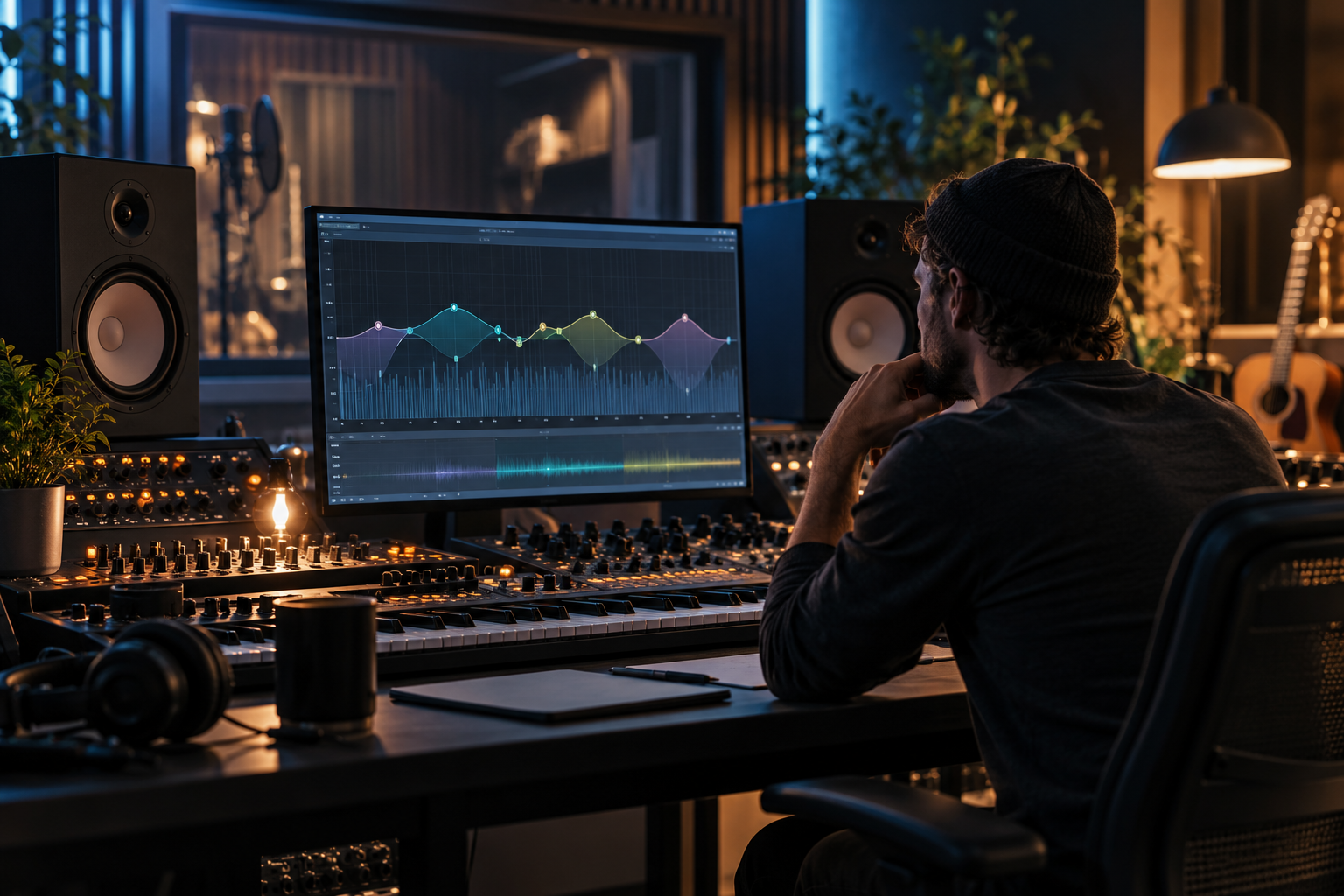
Mastering The Mix has put CARBON Q on sale for $56, down from its usual $69, and the deal runs until November 6. I have been running it on mixes for a few weeks now, and I have opinions.
First, the thing nobody seems to be talking about: CARBON Q is not a normal EQ. It is not trying to be your surgical tool. It is not trying to be a vintage emulation either. It sits somewhere in between, and that middle ground is exactly why I keep reaching for it on buses when I would normally not bother with a “character” EQ.
What CARBON Q actually is
Eleven bands. That sounds like a lot, and it is, but they are not eleven fully parametric bands stacked in a row. The design splits into a few zones: fixed low and high shelves, a set of broad musical bands for tone shaping, and a few narrower cuts for problem areas. The bands are deliberately connected, meaning the gain you dial in on one band influences the Q and behavior of its neighbors. You are not setting eleven independent slices and forgetting them. You are shaping a curve.
That is either a feature or a dealbreaker depending on how you mix. If you are the type of engineer who soloes a band, hunts down a resonance at 2.3 kHz, and notches it 4 dB, this plugin will frustrate you. If you are the type who moves a fader, hears the whole bus open up, and leaves it alone, this is one of the fastest EQs I have used.
There is no analyzer. I know that sounds like a negative in 2026, when TDR Nova gives you free dynamic EQ with full spectrum display. It is not. I have TDR Nova. I use TDR Nova. But I do not want an analyzer on my mix bus most of the time, because an analyzer turns mixing into whack-a-mole. CARBON Q forces you to listen. That sounds pretentious. It is also true.
The sound
The curves are broad. When you push a high shelf, it moves air without adding that glassy 12 kHz fizz you get from a lot of clean digital shelves. When you cut low mids, the bottom stays solid instead of hollowing out. That is the “carbon” part of the name, I assume: it is adding some weight and smoothing as it shapes.
On a drum bus, I found myself cutting around 300 to 400 Hz with the broad band and slightly shelving up top, and the kit glued together without a compressor. That is a useful trick when you are already compressing and do not want to stack more gain reduction. On vocals, the top shelf is where it earns its keep. It brightens without sibilance, which is rare for a shelf that moves this much.
Where it does not work: anything that needs to be surgically precise. If you are trying to notch out a ringing snare overtone or a room mode, this is the wrong tool. Reach for Soothe 2 or Gullfoss or even the free TDR Nova, all of which do narrow dynamic work far better. CARBON Q is not a resonance killer. It is a tone shaper.
The connected band thing, honestly assessed
Here is where I have to push back on the marketing. The “connected” behavior is real and it does produce musically coherent curves, but it also means you cannot always predict exactly what a single band move will do. I have made a 2 dB adjustment on one band and heard the neighboring region shift by what felt like a full dB. That is not a bug. It is the design. But if you are mixing to a target curve, or matching a reference, it adds a step of guesswork.
My workaround: make one move, listen, then stop. Do not chase. The plugin rewards decisiveness and punishes fiddling. That is the opposite of how most modern EQs behave, where endless small adjustments are frictionless.
CPU and format
It is lightweight. I ran instances on every bus in a 60-track session and saw no meaningful CPU movement on an M1 Max. That matters more than any tonal debate, because a mix bus EQ that eats 5 percent of your chip per instance is a mix bus EQ you stop using. This one does not.
Formats are VST3 and AU on Windows and Mac. No AAX, so Pro Tools users are out unless they wrap it. That is a real limitation and worth knowing before you buy.
The price question
At $56, this lands in the same zone as a lot of sale-priced EQs. Right now MAAT has SantaCruzEQ6 at $39 instead of $199 until October 5, and that one gives you six analog-inspired architectures in one lightweight plugin. That is a genuinely different proposition and arguably better value if you want variety. CARBON Q is the opposite approach: one architecture, tuned carefully, eleven bands, no switching.
If you already own a good clean EQ (Pro-Q, TDR Nova, your DAW’s stock) and a good character EQ (Analog Obsession MERICA, any Pultec clone, the Vox Samples Rainbow Bird EQ if you want something free and fun), do you need CARBON Q? Probably not. It is a luxury.
If you mix a lot of buses and you want one EQ that sounds expensive and takes thirty seconds to set, it earns its slot. I have not taken it off my mix bus since I installed it.
Who should skip it
Three groups. First, anyone doing surgical resonance work: this is the wrong tool, and the free options beat it for that job. Second, Pro Tools users, because no AAX is a hard stop. Third, anyone who needs an analyzer to feel confident making a move. CARBON Q will feel like driving with the windshield painted over.
Everyone else, the $56 price is real and it expires November 6. Demo it first. Spend an hour on a bus you have already mixed, and if you find yourself making fewer moves and liking the result more, buy it.